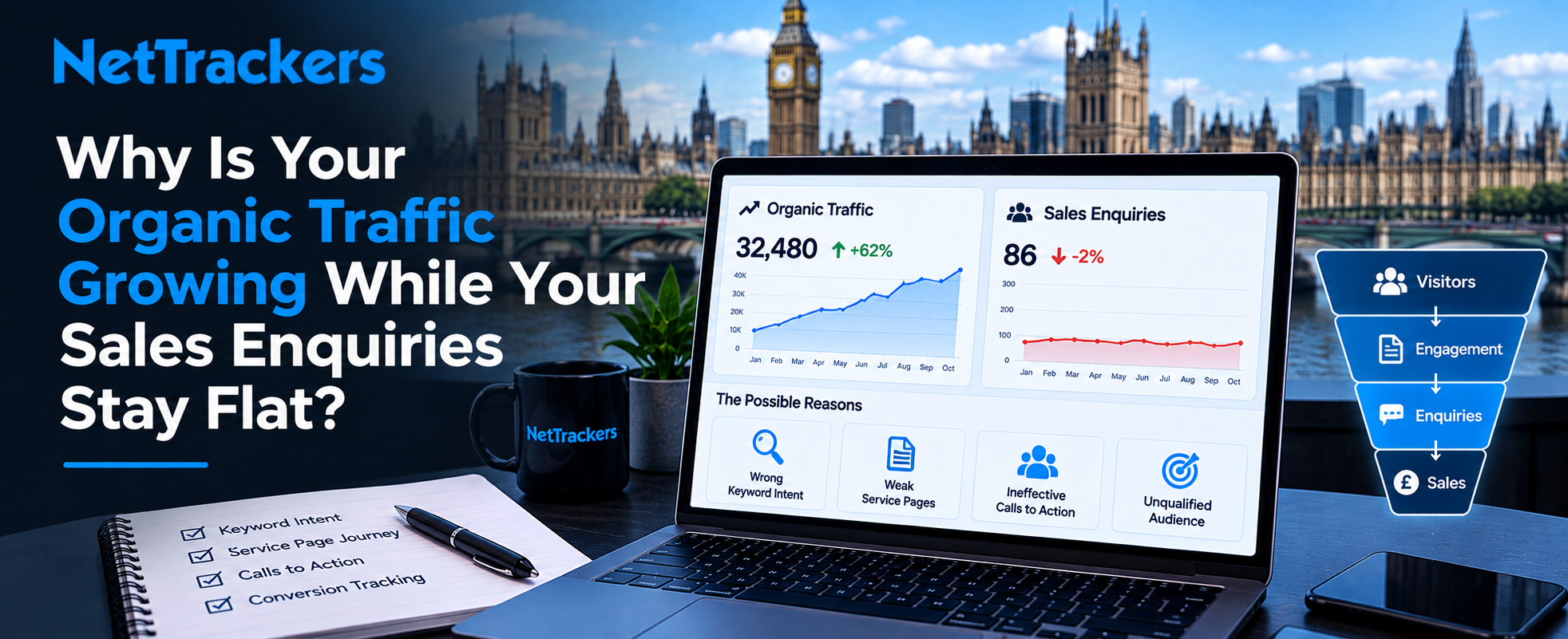
Your website is attracting more visitors from Google, but the number of sales enquiries has barely changed. Search Console shows improving impressions and clicks, your analytics dashboard reports more organic sessions, and several keywords are moving upwards. Despite these encouraging indicators, your sales team is not receiving more qualified conversations or contact form submissions. This disconnect can occur when organic search growth attracts visitors who are unlikely to become customers, or when your website fails to guide interested prospects towards the next step. Understanding the difference between traffic growth and commercial performance is essential before investing further in search engine optimisation.
For UK businesses, the challenge is rarely solved by chasing more keywords without examining the customer journey. Some visitors arrive looking for general information, while others are actively comparing suppliers, pricing and services. Both audiences can be valuable, but they should not be expected to convert at the same rate. Effective organic SEO services should connect relevant search demand with useful content, credible service pages and measurable conversion opportunities. The objective is not simply to increase website visits but to attract the right audience and help qualified prospects take action.
Why Doesn't More Organic Traffic Always Mean More Leads?
Organic traffic measures visits from unpaid search results, but it does not automatically indicate commercial interest. A visitor researching a broad industry topic may have no immediate intention of purchasing a service. Another visitor searching for a specific provider may be much closer to making an enquiry. When traffic growth comes primarily from informational searches, lead generation may remain unchanged even as visitor numbers rise. Businesses need to understand which searches are driving growth and what those visitors expect to find.
What Is the Difference Between Traffic and Qualified Traffic?
Traffic represents the volume of visitors reaching your website, while qualified traffic reflects how closely those visitors match your intended customers. A qualified visitor may have a relevant business requirement, suitable location, purchasing authority or identifiable need for your services. These characteristics cannot always be determined from analytics alone, but search queries and subsequent actions can provide useful indicators. A website attracting fewer relevant visitors may generate more meaningful enquiries than one receiving substantially more general traffic. This is why traffic quality deserves as much attention as traffic volume.
Why Can Informational Content Attract Visitors Who Never Enquire?
Educational articles often target questions that people ask during the early stages of research. Someone searching for a definition, tutorial or industry explanation may want information rather than a commercial solution. Such content can still build awareness and support future purchasing decisions. However, its contribution to enquiries depends on whether the subject is relevant to your services and whether readers have a logical next step. Publishing informational content without considering commercial relevance can produce impressive traffic reports but limited business impact.
Can Organic Traffic Growth Hide Falling Conversion Rates?
Yes, increasing traffic can conceal a decline in the proportion of visitors who complete meaningful actions. For example, if a website receives 2,000 organic visits and generates 40 enquiries, its enquiry conversion rate is 2%. If visits increase to 4,000 but enquiries remain at 40, the rate falls to 1%. These figures are illustrative rather than NetTrackers client performance data. The example demonstrates why businesses should review conversions alongside sessions instead of treating traffic growth as proof of improved commercial results.
Are Your Keywords Attracting the Wrong Audience?
Keyword targeting determines which searches your website is likely to address. A keyword may have substantial search demand but attract users whose needs do not match your services. Broad terms can bring together students, jobseekers, researchers and potential customers within the same results. If your content does not distinguish these audiences, organic growth may not translate into sales opportunities. Reviewing search intent helps identify whether the keywords driving traffic support your commercial objectives.
How Does Search Intent Affect Lead Generation?
Search intent describes the purpose behind a user's query. Informational searches usually indicate a desire to learn, while commercial investigation searches often involve comparing solutions or evaluating providers. Transactional searches may indicate readiness to take a specific action, although the distinction is not always clear. Businesses should assess the likely intent behind important keywords before deciding which page should target them. Matching content to intent improves the relevance of the visitor's experience and creates a more appropriate route towards an enquiry.
Why Are High-Volume Keywords Not Always the Best Targets?
High search volume can indicate substantial interest, but it does not establish the commercial value of a query. A broad keyword may attract thousands of users who are outside your service area or unlikely to purchase. More specific searches may generate fewer visits but reflect clearer requirements. Keyword prioritisation should consider relevance, intent, ranking feasibility and potential business value together. A balanced strategy can include broader awareness content without allowing it to dominate commercial priorities.
How Can Local Search Intent Improve Lead Quality?
Local search terms can help businesses reach users looking for services within a particular geographic market. A company serving London may benefit from targeting relevant local service queries rather than competing exclusively for national informational searches. However, location relevance must be supported by accurate service information and useful page content. Businesses evaluating Organic SEO London should consider how their website addresses local customer needs and differentiates its services. Geographic targeting is most useful when it reflects the areas where the business can genuinely serve customers.
What If Your Website Ranks for Unrelated Queries?
Search Console may reveal that some pages attract impressions or clicks for topics outside your intended commercial focus. This does not automatically indicate a problem, because useful content can rank for several related queries. However, a growing proportion of irrelevant traffic may make overall performance appear stronger than it is. Review the pages and queries responsible for the increase before changing your strategy. The goal is to strengthen commercially relevant visibility rather than remove every informational keyword.
How Can Service Pages Convert Informational Visitors?
Informational content introduces a topic, while service pages explain how a business can help solve a relevant problem. The transition between these page types should feel useful rather than forced. A visitor who has just learned about a challenge may want to understand available solutions, expected processes and the next practical step. Clear internal links and relevant calls to action can support this journey. Businesses should review whether their educational content connects naturally to the services they actually provide.
Why Should Blog Content Link to Relevant Services?
A useful article may answer a question without explaining how the reader can obtain professional support. Relevant internal links allow interested visitors to explore a service when they are ready. For example, an article explaining technical website problems could link to a service page that describes professional investigation and remediation. The link should match the surrounding topic and provide a clear reason to continue reading. Adding unrelated commercial links to every paragraph can undermine the user experience.
What Should a High-Converting Service Page Include?
A service page should explain what the business offers, who the service is suitable for and which problems it addresses. It should also describe the engagement process clearly enough for visitors to understand what happens after making contact. Relevant evidence, accurate service details and accessible contact information can help reduce uncertainty. The page should avoid unsupported promises or vague claims that make it difficult to evaluate the offering. Strong service pages make the next step understandable without pressuring visitors.
How Can Calls to Action Improve the Visitor Journey?
A call to action tells visitors what they can do after reading a page. Examples include requesting an audit, arranging a consultation or discussing a specific business challenge. The most appropriate action depends on the visitor's likely stage in the decision-making process. An educational article may benefit from a lower-commitment next step, while a detailed service page can present a more direct enquiry opportunity. Clear wording and sensible placement can make these options easier to find.
Why Does Internal Linking Matter for Commercial Pages?
Internal links help users navigate between related topics and services. They also support search engines in discovering pages and understanding their relationships within the website. Commercial pages that receive few relevant internal links may be harder for visitors to reach from informational content. A structured linking approach can connect useful articles, supporting resources and service pages without excessive repetition. The objective is to create a coherent website journey rather than maximise the number of links.
Could Your Website Be Losing Leads After Visitors Arrive?
Even relevant visitors may leave without enquiring if the website makes the next step difficult. Confusing navigation, unclear service descriptions and unnecessary form fields can create friction. Mobile usability problems may also affect visitors who are ready to contact the business. These issues should be investigated using appropriate analytics and user experience evidence. Improving conversion performance requires understanding where visitors encounter difficulties rather than assuming that every page needs a redesign.
Are Your Contact Forms Too Complicated?
A contact form should collect enough information to support a useful response without creating unnecessary barriers. Long forms may discourage some visitors, particularly when they are making an initial enquiry. However, certain B2B services may reasonably require additional details to assess suitability. Businesses should evaluate which fields are essential and explain why information is requested where appropriate. Form performance can be reviewed through completion data and testing rather than assumptions alone.
Does Your Mobile Experience Support Enquiries?
Mobile visitors should be able to understand the service, navigate the page and complete relevant actions without avoidable difficulty. Small buttons, intrusive overlays and poorly arranged forms can interfere with this process. A page may appear acceptable on a desktop while creating problems on smaller screens. Testing should include real devices or suitable emulation alongside accessibility and usability checks. The priority is to make important information and contact options practical to use.
Are Your Calls to Action Easy to Find?
Visitors should not have to search extensively for a relevant contact option. A clear call to action near important service information can help users understand the next step. Longer pages may benefit from additional opportunities to enquire at natural decision points. However, repeating aggressive prompts throughout the page can become distracting. Placement should reflect the page's content, user intent and observed behaviour.
Can Slow or Broken Pages Affect Enquiries?
Technical problems can interrupt the customer journey even when search rankings remain stable. Slow-loading forms, broken buttons and failed submissions may prevent interested visitors from contacting the business. These issues can be particularly difficult to detect if analytics records only page visits rather than successful form completions. Regular functional testing helps confirm that important enquiry paths work as intended. Businesses should investigate technical conversion problems alongside search performance.
Which SEO Metrics Matter Beyond Rankings and Sessions?
Rankings and sessions are useful indicators, but they describe only part of organic search performance. Businesses also need to understand what visitors do after arriving and whether those actions support commercial objectives. Useful measures may include qualified enquiries, conversion rates, landing-page performance and eventual sales outcomes. The right reporting framework depends on the business model and available tracking data. A meaningful SEO report should explain commercial performance rather than simply present improving graphs.
Why Should You Track Organic Enquiry Conversion Rates?
An organic enquiry conversion rate compares recorded enquiries with the relevant volume of organic visits or users. It helps businesses understand whether changes in traffic are accompanied by changes in enquiry activity. The calculation must use consistent definitions and measurement periods. Differences in consent settings, tracking implementation and attribution can affect the reported figures. Conversion rates are most useful when interpreted alongside enquiry quality and business context.
What Is the Difference Between Leads and Qualified Leads?
A lead may be any recorded enquiry, while a qualified lead meets criteria that make it relevant to the business. Qualification might consider service requirements, location, budget, project timing or other appropriate commercial factors. A large number of irrelevant submissions can inflate lead totals without improving sales opportunities. Businesses should establish clear definitions with their sales teams. This makes it easier to evaluate whether SEO is attracting the intended audience.
How Can Landing-Page Reports Reveal Problems?
Landing-page reports show which pages visitors first access when arriving from organic search. Comparing these pages with enquiry outcomes can reveal differences in performance. A blog attracting many visitors but few enquiries may be serving an informational audience effectively rather than failing. A commercial service page receiving relevant visits but generating no contact activity may warrant closer investigation. Interpretation should consider search intent, traffic volume and the page's intended role.
Should You Track Revenue From Organic Search?
Revenue attribution can provide useful commercial context when suitable data is available. However, B2B purchases often involve multiple visits, channels and decision-makers before a sale is completed. A single attribution model may not capture every contribution made by organic search. CRM information and agreed reporting definitions can help connect enquiries with later sales outcomes. Businesses should recognise the limitations of attribution rather than present uncertain figures as exact results.
How Can Organic SEO and Consulting Work Together?
SEO performance problems often involve several connected factors rather than one isolated issue. Keyword selection, page relevance, technical accessibility and conversion journeys all influence the value of organic traffic. Effective organic SEO services should therefore be evaluated against the business's commercial priorities as well as its search visibility. A consultant can help determine which issues require investigation and which improvements deserve attention first. The most useful approach connects technical evidence, search intent and lead-generation performance.
What Does an SEO Consultant Actually Review?
An SEO consultant may examine search performance, technical website conditions, keyword targeting and content structure. The review can also consider how visitors move between informational pages, services and enquiry opportunities. Findings should be supported by available evidence rather than generic recommendations. The consultant should explain which issues are confirmed and which require further testing. This provides a clearer basis for deciding where to invest time and resources.
When Should You Consider an SEO Services Consultant?
Businesses may seek an SEO Services Consultant when internal teams need specialist support with strategy or troubleshooting. This can be particularly useful when rankings are improving but commercial outcomes remain disappointing. The engagement should begin with a clear understanding of business goals and existing performance data. Recommendations should prioritise issues that are both relevant and actionable. A defined scope helps prevent the project from becoming an unfocused collection of SEO tasks.
What Is the Role of a Search Engine Optimization Consultant?
A Search Engine Optimization Consultant evaluates how a website can improve its relevance, accessibility and visibility in organic search. The work may involve technical analysis, content planning, internal linking and performance measurement. Different projects require different levels of investigation and implementation support. A consultant should explain the reasoning behind recommendations and how their impact will be evaluated. The focus should remain on sustainable improvements rather than guaranteed ranking positions.
How Do You Evaluate a Professional SEO Consultant?
A Professional SEO consultant should be able to explain technical findings and commercial priorities in clear language. Ask how the proposed work relates to your business goals and what evidence supports the recommendations. Clarify which deliverables are included and who will be responsible for implementation. Reporting should distinguish measurable outcomes from estimates and assumptions. Avoid relying solely on promises of rapid rankings or traffic growth.
How Can You Improve Keyword Targeting Without Losing Existing Rankings?
Changing keyword targeting requires care when a website already attracts valuable organic traffic. Removing successful content or rewriting high-performing pages without analysis may introduce unnecessary risk. The objective should be to strengthen commercial relevance while preserving useful coverage of existing search intent. This is especially important for pages that already rank well for location-specific searches. Improvements should be based on page-level evidence rather than broad assumptions about keyword performance.
Should You Remove Informational Keywords?
Informational keywords can support brand awareness, early-stage research and future commercial journeys. Removing content simply because it does not generate immediate enquiries may reduce useful search visibility. Instead, review whether the topic is relevant to the business and whether the page serves a clear purpose. Some articles may benefit from stronger contextual links or more helpful next steps. Others may remain valuable educational resources without requiring a direct sales focus.
How Can You Protect Existing Local Visibility?
Start by identifying which pages and queries already perform well in the target location. Review their current search intent, content and internal links before making significant changes. Preserve useful information that supports their existing relevance. If improvements are necessary, introduce them deliberately and monitor the affected queries. This approach reduces the risk of disrupting successful local search coverage while addressing weaker commercial journeys.
Should You Target More Commercial Keywords?
Commercial keywords can help reach users who are evaluating services or providers. However, adding them indiscriminately to existing pages may weaken clarity and create competing content. Review whether each keyword aligns with a distinct user need and an appropriate landing page. Some queries may fit an existing service page, while others justify a dedicated resource. Prioritisation should consider search intent and business value rather than keyword difficulty alone.
How Can You Diagnose the Organic Traffic-to-Enquiry Gap?
A structured diagnosis begins by establishing where organic traffic growth is occurring. The next step is to determine whether those visitors match the business's intended audience and whether relevant enquiry paths are functioning. Search Console, analytics, CRM records and technical testing can provide complementary evidence. Each source has limitations, so findings should be interpreted carefully. The investigation should produce specific actions rather than a generic recommendation to increase traffic.
Step 1: Identify the Pages Driving Organic Growth
Review which landing pages account for the largest increases in organic visits. Separate informational articles from service pages and other commercially important content. Examine whether growth is concentrated in a small number of topics. Compare relevant date ranges while considering seasonal changes. This establishes where the additional audience is entering the website.
Step 2: Review the Search Queries Behind Those Pages
Use Search Console to understand which queries generate impressions and clicks for important pages. Group queries by likely informational, commercial or navigational intent where practical. Identify terms that closely match your services and target customers. Remember that Search Console does not provide every query and does not directly reveal individual visitor identities. The purpose is to understand the general relevance of the traffic being attracted.
Step 3: Evaluate the Journey Towards Enquiry
Review whether visitors can move naturally from the landing page to relevant service information. Check navigation, internal links, calls to action and contact options. Test important forms and other enquiry mechanisms. Where suitable tracking exists, examine how users interact with these elements. Avoid assuming that every exit represents a failure, particularly on pages designed to answer informational questions.
Step 4: Assess Lead Quality With Sales Data
Compare recorded enquiries with the leads that your sales team considers relevant. Identify whether unsuitable submissions are associated with particular services, locations or search topics. Review available CRM records without overstating the precision of channel attribution. Consistent lead qualification criteria make these comparisons more meaningful. This step connects search performance with the actual commercial opportunities generated.
Step 5: Prioritise Changes and Measure Their Impact
Create a shortlist of issues supported by the investigation. Prioritise improvements according to potential commercial value, implementation effort and confidence in the evidence. Changes may involve content, internal links, forms, tracking or technical website conditions. Establish suitable measures before implementing substantial updates. Review the results over an appropriate period rather than expecting immediate changes from every adjustment.
When Should You Review Your Organic SEO Strategy?
An SEO strategy should be reviewed when its reported performance no longer aligns with business outcomes. This may happen when traffic grows without enquiries, important commercial pages lose visibility or the website begins attracting unsuitable audiences. Changes to services, locations or customer requirements can also justify a review. Organic SEO services should support the business's current priorities rather than remain fixed around an outdated keyword list. Regular evaluation helps identify where adjustments are justified and where successful work should be preserved.
What Are the Signs Your Strategy Needs Attention?
One warning sign is a sustained increase in organic sessions without corresponding growth in relevant enquiries. Another is a growing dependence on informational pages while core service pages remain difficult to discover. Poor conversion tracking can also prevent the business from understanding whether SEO contributes to sales opportunities. A strategy may need reviewing when commercial keywords consistently underperform despite broader traffic gains. These patterns should prompt investigation rather than immediate assumptions about the cause.
How Often Should SEO Performance Be Reviewed?
Monitoring frequency depends on website size, business priorities and the availability of reliable data. Important technical problems may require immediate attention, while broader content and conversion trends need longer observation periods. Monthly reporting can help identify emerging patterns, but strategic changes should not be driven by every short-term fluctuation. Businesses should compare suitable periods and account for seasonality. The review process should focus on decisions that can be supported by the evidence.
Why Is an SEO Audit a Useful Starting Point?
An audit can help determine whether the problem originates in keyword targeting, technical conditions, page structure or conversion journeys. It should also identify gaps in tracking that make performance difficult to evaluate. Businesses exploring SEO audit services UK can use an initial review to discuss the issues affecting their website. The most useful outcome is a prioritised explanation of what needs attention and why. An audit should support practical decisions rather than simply produce a long list of automated warnings.
How Can NetTrackers Help Improve Organic Search Lead Generation?
NetTrackers provides SEO and digital marketing services for businesses seeking stronger online visibility and commercially relevant website performance. When organic traffic increases without more enquiries, the starting point is to understand which pages attract visitors and how those visitors move through the website. A structured review can examine keyword intent, technical accessibility, service-page content and enquiry opportunities. The findings can help businesses decide whether they need better targeting, clearer customer journeys or improvements to measurement. The objective is to make SEO activity more closely aligned with meaningful business outcomes.
Why Focus on Commercial Relevance Rather Than Traffic Alone?
Traffic is valuable when it reaches people who may benefit from the business's services. However, growth driven by unrelated searches may contribute little to sales activity. Reviewing the relationship between keywords, landing pages and qualified enquiries helps clarify where SEO resources should be directed. Commercial relevance should be evaluated alongside visibility, user experience and content quality. This creates a more balanced basis for long-term planning.
What Should You Discuss With the NetTrackers Team?
Explain which services and locations are most important to your business. Share whether your main concern is poor lead quality, low enquiry volume or uncertainty about conversion tracking. Identify any recent website changes that may have affected performance. Discuss the available analytics and search data so that the investigation can be scoped appropriately. Clear objectives help establish the most useful next steps.
Conclusion: Why Is Traffic Growth Only Part of SEO Success?
Increasing organic traffic can be a positive development, but it does not automatically mean that a website is generating more business. Search intent, keyword relevance, service-page quality and conversion journeys all influence whether visitors become qualified enquiries. Businesses should evaluate these factors alongside rankings and sessions rather than relying on visibility metrics alone. A structured review can identify where potential opportunities are being lost and which improvements deserve priority. The most effective SEO strategy connects useful search visibility with measurable commercial objectives.
Request an Organic Search and Lead-Generation Audit
If your website is attracting more organic visitors but your sales enquiries remain flat, investigate the gap before investing in more traffic. Review the pages and keywords driving growth, assess whether service journeys are clear and confirm that enquiry tracking works correctly. NetTrackers can help you discuss the issues affecting your organic search performance and identify suitable next steps. Contact the team to explore an audit focused on technical conditions, search intent and lead-generation opportunities. Call +44 20 4572 4940 or visit https://nettrackers.co.uk/ to get started.