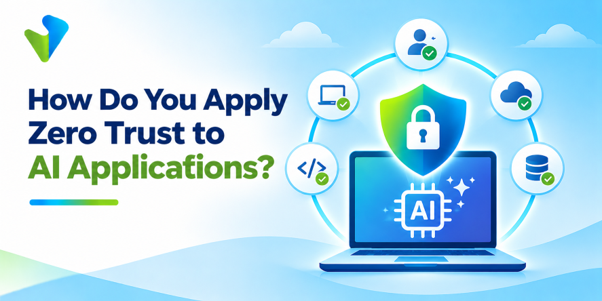
To apply zero trust to AI applications, enforce it in three directions: control who can reach each AI app with least-privilege, identity-based access; strictly limit what the AI app or agent itself can reach (data, tools, other systems); and continuously inspect the traffic flowing in and out, treating every prompt as untrusted. The principle is the same as always - never trust, always verify - but AI's ability to take input and take action makes applying it essential.
Zero trust was built for a world of users, devices, and apps. Then AI applications arrived and broke the mold. An AI app doesn't just sit there waiting to be used - it reads untrusted natural language, makes decisions, and increasingly acts on its own, reaching into data and triggering other systems. Treating it like an ordinary application leaves gaping holes. So the real question for security teams isn't whether to apply zero trust to AI - it's how. Here's a practical way to think about it.
Why AI applications need zero trust
AI applications are unusual assets. Their input is practically executable: a cleverly worded prompt can override instructions or exfiltrate data. They're non-deterministic, so the same request can behave differently. And agentic AI can autonomously access databases, call APIs, and trigger actions - turning a compromised AI into a fast-moving threat. Implicit trust, already dangerous for traditional systems, becomes reckless when the asset can be manipulated by language and can act without a human. Zero trust - never trust, always verify, assume breach - is the architectural fit.
The three zero-trust questions for AI
The clearest way to apply zero trust to an AI application is to ask three questions.
1. Who can reach the AI app? Access to AI applications should never be open or network-wide. Enforce least-privilege, per-application access based on verified identity and device posture - exactly what ZTNA provides. A contractor, an employee, and an unmanaged device should get different, scoped access, and trust should be re-checked continuously, not just at login.
2. What can the AI app - or agent - reach? This is the question most teams miss. The AI itself is an actor, and it needs its own least-privilege boundaries. An AI agent should reach only the specific data sources, tools, and systems its task requires - nothing more. Microsegmentation isolates AI workloads so a compromised model can't move laterally, and tightly scoped permissions limit what an agent can do if a prompt manipulates it.
3. What's flowing in and out? Zero trust assumes the traffic itself is suspect. Every prompt coming in should be treated as untrusted input and inspected for injection and policy violations; every response and upload going out should be scanned by data loss prevention to stop sensitive data from leaking. Inspecting AI traffic in real time turns the network into an active guardrail.
Applying the core principles to AI
Map each zero-trust principle onto AI specifics. Never trust by default: no user, device, or AI agent gets implicit access to apps, data, or tools. Least privilege: scope access tightly - for the humans using AI and for the AI acting on their behalf. Continuous verification: reassess identity, device posture, and context throughout every session, since AI interactions are dynamic. Assume breach: design so that a manipulated prompt or compromised model is contained by segmentation, not free to spread. Together, these shrink the blast radius of anything that goes wrong.
Don't forget the AI agent
Here's the part that's genuinely new. In agentic systems, the AI is an identity in its own right - one that acts fast and at scale. Applying zero trust means treating agents like any other untrusted actor: give them the least privilege needed, require human-in-the-loop checkpoints for high-impact actions, cap how many requests and tokens they can consume, and segment what they can touch. An over-permissioned agent with a poisoned prompt is the AI-era equivalent of a domain admin with a stolen password. Zero trust for AI isn't complete until the agents are governed too.
Where Versa fits
Versa delivers the pieces needed to apply zero trust to AI from one platform. Its ZTNA enforces least-privilege, identity-based access to AI applications with continuous verification; adaptive microsegmentation isolates AI workloads and contains lateral movement; and its GenAI Firewall inspects AI traffic in real time - governing which AI apps users reach and applying DLP to prevent sensitive data from leaving in prompts or responses. Because all of this runs on the unified VersaONE platform, zero trust for AI is an extension of existing policy, not a new silo to manage.
Versa's blog on building an AI-resilient, zero-trust architecture explores how these controls work together.
Frequently asked questions
What does zero trust mean for AI applications?
It means no implicit trust for users reaching an AI app, for the AI or agent reaching data and tools, or for the traffic itself - access is least-privilege and continuously verified.
How do you apply zero trust to AI agents?
Treat agents as untrusted identities: grant least privilege, add human-in-the-loop checks for high-impact actions, cap their resource use, and segment what they can reach.
Does zero trust stop prompt injection?
It limits the damage. Inspecting prompts catches many attacks, and least-privilege plus segmentation contain what a manipulated AI can actually do.
The bottom line
Applying zero trust to AI applications comes down to three directions: control who reaches the AI, constrain what the AI can reach, and inspect everything flowing through it - while governing autonomous agents as untrusted actors. The principles are familiar; AI just raises the stakes. For zero trust built to cover AI from one unified platform, Versa is a strong place to start.