Most people pick a backpack by colour, discount and whether the laptop slot looks right. Litres come last, if they come at all. That is where the trouble starts. A bag that is too small leaves your charger, lunch box and umbrella in your hands. A bag that is too big turns into a dumping ground, and your shoulders pay for it by evening.
So before you add anything to the cart, it helps to understand what that "L" on the label really means.
What litres actually tell you
Litres show how much space is inside the bag. They do not show how much weight it can carry, and they say nothing about how comfortable it feels. Two bags marked 20L can feel very different depending on the shape, the padding and how the compartments are arranged.
As a rough guide:
- Up to 15L: laptop, charger, wallet, phone, a small bottle. Light daily carry.
- 16L to 25L: the everyday range. Laptop plus lunch, a notebook, a power bank and a few extras.
- 26L to 35L: a day bag that doubles as a weekend bag. Gym kit, a change of clothes, or a short trip.
- 40L and above: multi-day treks and rucksack territory. Most city users do not need this.
Mistake one: buying small because the laptop fits
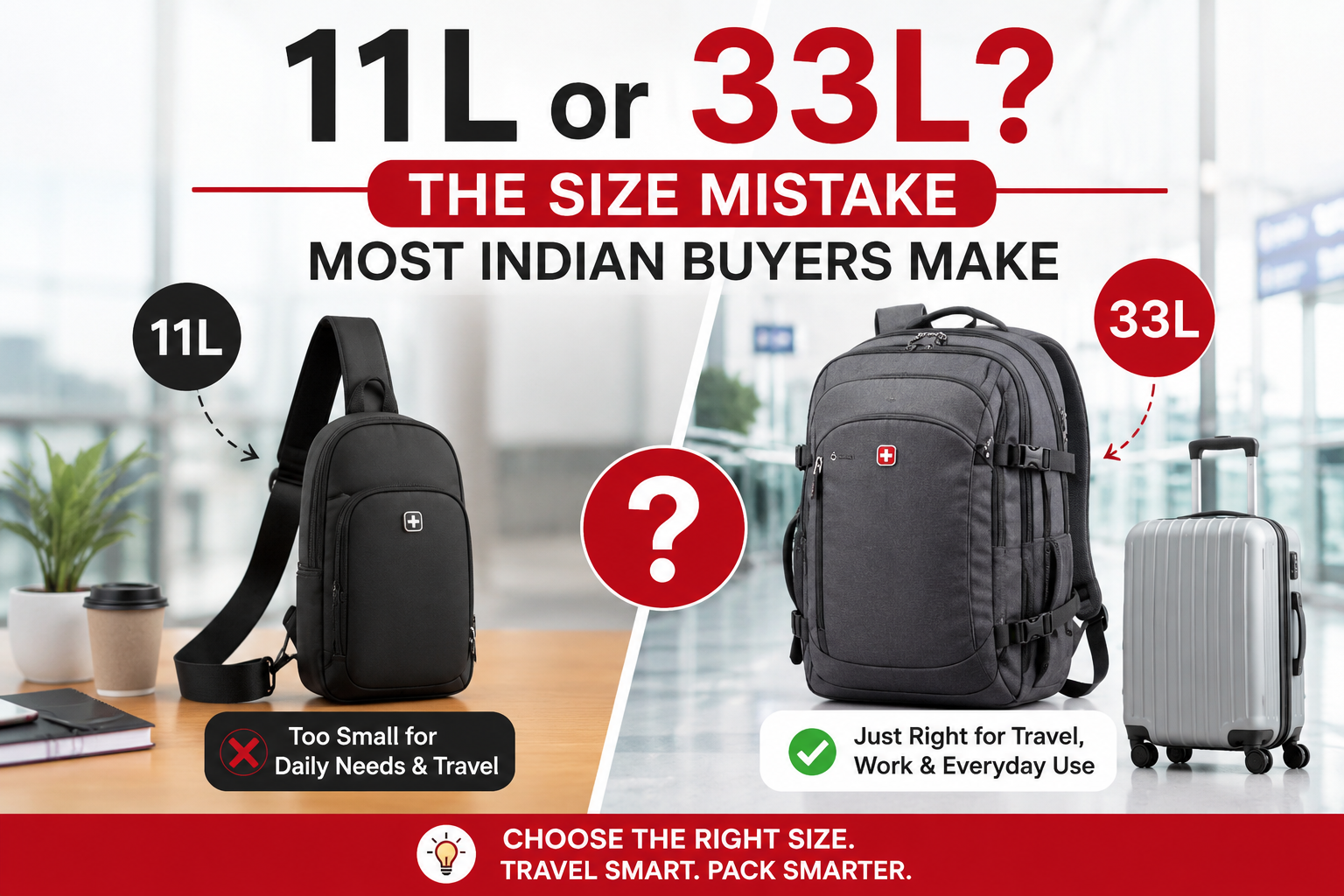
This one catches a lot of first-time buyers. Take the 11L laptop backpack that fits a 15.4-inch laptop, like the Knox 11L. The laptop goes in without trouble. That does not mean the bag has room for everything else.
Laptop compartment size and total capacity are two separate things. A compact bag can have a roomy laptop sleeve and almost nothing left over for the rest of your day. If you carry a charger, a mouse, a tiffin, a bottle and an umbrella, you will feel the squeeze within a week.
An 11L bag works well when your day is simple: laptop, charger, phone, wallet. If that describes you, it is a good choice. If not, go up a size.
Mistake two: buying big "just in case"
The 30L to 33L bags look tempting, especially when the price is low. More space feels like more value. But a bigger bag gets filled, whether you need to carry that stuff or not.
A common guideline says a loaded backpack should stay under roughly 10 to 15 percent of your body weight. For many people that is only 6 to 9 kg, and a half-packed 33L bag with a laptop in it can cross that without much effort. Add a water bottle and a jacket and you are well past it.
There is also a practical issue on flights. Most domestic airlines in India allow around 7 kg of cabin baggage, though the exact rule depends on the airline and the fare, so check before you fly. A full 33L backpack can reach that limit before you have packed anything for the trip.
Match the size to your actual day
Forget the "best size" and think about your own routine instead.
Office commute by metro or local train. In a crowded coach, a compact bag that sits close to your back is easier to manage than a big one that bumps into people. 15L to 21L usually does the job. A laptop, lunch and a few essentials fit, and you can still turn around without apologising.
College or coaching classes. Books are heavy and bulky. Something in the 21L to 30L range makes sense here, as long as the straps are padded and the back panel is not flat and hard.
Weekend trips by train or bus. This is where 30L to 35L earns its place, such as the Snowflake 33L. It carries a laptop and a small clothes bundle without needing a separate bag.
Monsoon months. Pack a little extra in July and August. A light rain jacket or a spare dry bag takes space you do not need in winter. If your commute gets wet, size up slightly or keep the bag's rain cover handy.
Gym after work. Shoes need their own space, and sweaty clothes should not touch your laptop. A bag with a separate compartment matters more than raw litres here.
A quick test before you buy
It takes five minutes and saves a lot of regret.
Put everything you carry on a normal day on the floor. Laptop, charger, bottle, lunch, umbrella, whatever else you drag along. Now look at the pile. Weigh it if you can. If it fits comfortably in your head as "one bag", that is your size. If the pile is bigger than you expected, the problem might be what you carry, not the bag.
Most people find they land somewhere around 18L to 25L. Not the smallest bag, not the biggest.
A simple way to decideYour routineSize to look atLaptop, charger, phone, wallet only11L to 16LOffice plus lunch and daily extras17L to 24LCollege, books, or office plus gym24L to 30LWeekend trips and short travel30L to 35LMulti-day treks40L and aboveIf you want to compare real sizes side by side, the Swiss Military bags collection lists capacity in the product name, so you can filter by litres quickly without opening every page.
The takeaway
The size mistake is rarely about picking the wrong number. It is about picking a number without thinking about the day it has to survive. Be honest about what you carry, leave a little room to breathe, and ignore the urge to buy more space than you will ever use.
Get that right, and the bag stops being something you notice at all. That is usually the sign you picked correctly.