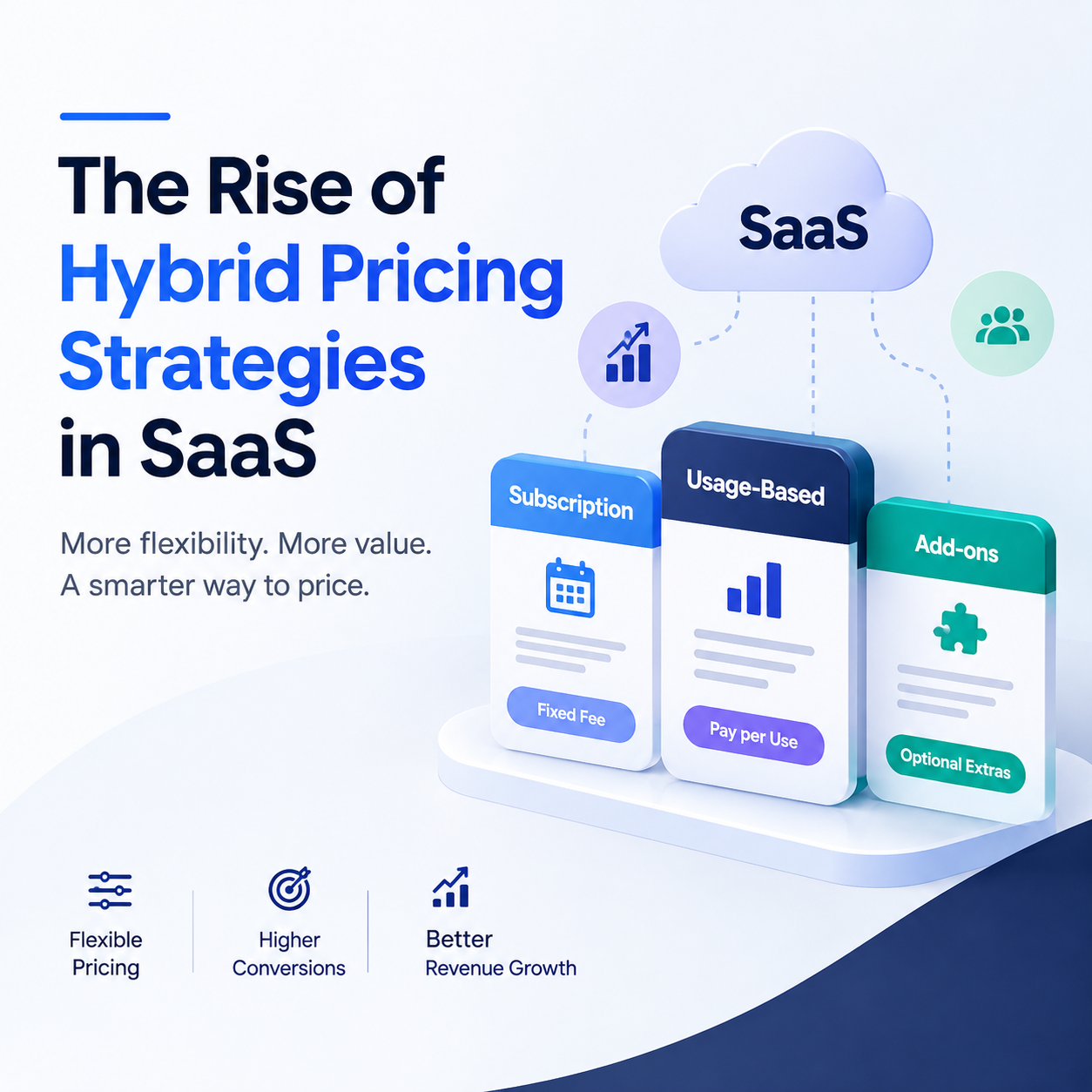
SaaS pricing has changed significantly as businesses look for better ways to balance customer expectations, revenue predictability, and the growing costs associated with digital products. A single pricing model does not always work for every customer, particularly when software usage can vary significantly from one account to another. This is where hybrid pricing strategies are gaining attention.
A hybrid pricing model combines two or more pricing mechanics within a single subscription. One of the most common approaches combines a predictable recurring fee, such as a platform or per-seat charge, with usage-based billing. Customers receive a stable base price while paying additional charges when their consumption increases. This structure gives SaaS companies an opportunity to monetize growth without making their pricing unnecessarily complicated.
What Is a Hybrid Pricing Model?
Hybrid pricing combines fixed and variable pricing components within the same subscription. Instead of relying entirely on a flat monthly fee or charging exclusively according to usage, businesses can combine the two approaches.
For example, a collaboration platform could charge $40 per user per month and include 100,000 API calls. If the customer exceeds that allowance, additional API calls could be billed at a predetermined rate. Similarly, a data platform could charge a $500 monthly platform fee and add a usage charge based on the amount of data processed.
The advantage of this structure is that the recurring component provides predictable revenue while the variable component allows pricing to increase alongside customer usage and value.
Why Are SaaS Companies Turning to Hybrid Pricing?
Traditional flat-rate pricing can become difficult to maintain when the cost of delivering a service increases with customer usage. This is especially relevant for SaaS products that rely heavily on APIs, artificial intelligence, cloud computing, storage, messaging, or data processing.
At the same time, a completely usage-based model can make monthly costs harder for customers to predict. Procurement teams may have difficulty approving software when they cannot estimate future spending with reasonable confidence.
Hybrid pricing addresses both challenges by combining predictability with flexibility. Customers understand their baseline commitment, while SaaS companies can capture additional revenue as customers consume more of the product.
Common Examples of Hybrid SaaS Pricing
There are several ways SaaS companies can structure hybrid pricing. The right approach depends on the product, customer behavior, cost structure, and value metric.
Seats Plus Included Usage and Overage
A company may charge customers according to the number of users while including a specific amount of usage in the subscription. Once the customer exceeds that allowance, additional consumption is billed separately.
This model is particularly useful for products where the number of users is predictable but usage varies significantly between accounts.
Platform Fee Plus Metered Usage
Another common model combines a fixed platform fee with a usage charge. A data processing company, for example, might charge a monthly platform fee and then bill customers according to gigabytes processed.
This allows the recurring fee to cover core platform costs while the usage component reflects the resources consumed by each customer.
Seats Plus Add-Ons and Usage
Some SaaS products combine seat-based pricing with feature add-ons and consumption-based charges. A communication platform might charge per agent, offer premium functionality for an additional monthly fee, and bill separately for SMS messages or voice minutes.
This gives customers greater control over what they purchase while allowing the SaaS provider to monetize different elements of its product.
Automating Hybrid Billing Without Spreadsheets
Managing hybrid pricing manually can quickly become complicated. Customer usage, subscription changes, allowances, credits, and overages all need to be calculated accurately before an invoice is generated.
The first step is reliable usage metering. Product activity should be captured through APIs, webhooks, or other event sources and associated with the correct customer and billing period. Duplicate events should be prevented through idempotency mechanisms, while usage should be aggregated according to the relevant meter.
The next step is centralizing customer, plan, entitlement, and pricing information. When this information is scattered across spreadsheets and disconnected systems, even a simple pricing change can create operational problems. A centralized billing system makes it easier to maintain pricing rules and apply them consistently.
A rating and proration engine is also important. The system should be able to apply allowances, tiers, overage rates, discounts, credits, and other pricing rules automatically. When a customer upgrades or adds seats during a billing period, the system should calculate the appropriate charges and credits according to the company's defined proration policy.
Finally, invoices should bring everything together. Base subscription fees, usage charges, credits, prorated amounts, and overages should appear as clear line items so customers can understand exactly how their invoice was calculated.
The Importance of Proration in Hybrid Pricing
Proration is one of the most important considerations when implementing a hybrid pricing strategy. A customer may upgrade their subscription, add users, change plans, or modify their usage allowance in the middle of a billing cycle.
If only the subscription fee is prorated while the usage allowance remains unchanged, the customer may receive an allowance that does not accurately correspond to the time spent on each plan.
A common approach is to calculate proration according to the number of days remaining in the billing cycle. The unused portion of the old plan is credited, while the remaining portion of the new plan is charged. The included usage allowance can then be adjusted according to the same time-based logic.
Some businesses may use second-based proration for greater precision. The important point is not necessarily which method a company chooses, but that the method is clearly defined and consistently applied.
How to Handle a Mid-Cycle Upgrade
Consider a customer who upgrades from a basic hybrid plan to a higher-tier plan halfway through the month. The billing system needs to determine the unused value of the old subscription and the applicable cost of the new plan for the remaining period.
At the same time, the usage allowance needs to be considered. If the old plan included 100,000 API calls and the new plan includes 250,000, the billing system needs to determine how the allowance applies across the two periods.
The invoice should clearly show the credit for the unused portion of the old plan, the prorated charge for the upgraded plan, and any applicable usage charges. Transparent line items make it easier for both customers and finance teams to validate the invoice.
What About Downgrades and Seat Changes?
Businesses should also establish clear rules for downgrades and seat modifications.
Many SaaS companies make downgrades effective at the next renewal because this avoids complex refunds and credit calculations. However, companies that support immediate downgrades can issue an account credit based on the unused portion of the existing subscription.
Seat additions can generally be prorated from the date they are added, while seat removals may take effect at the next renewal. These rules should be clearly communicated in the contract or terms of service.
Committed-usage plans require additional consideration. SaaS providers should define whether unused commitments expire, roll over into the next period, or convert into credits.
Building a Customer-Friendly Hybrid Pricing Strategy
Technology alone does not make a hybrid pricing model successful. SaaS businesses also need a pricing strategy that customers can understand.
Market research should be the starting point. Businesses need to understand how customers purchase similar products, which pricing structures competitors use, which features customers value, and how much variability customers are comfortable with.
It is also important to avoid introducing too many meters. If customers are charged according to dozens of different consumption metrics, the pricing page and invoices can quickly become difficult to understand. A better approach is to identify one or two usage metrics that closely correspond to the value customers receive.
Pricing communication matters just as much as pricing design. Customers should understand what is included, what triggers additional charges, how usage is measured, and what happens when they upgrade or downgrade.
Common Hybrid Billing Mistakes to Avoid
One of the most common mistakes is prorating the subscription fee without prorating the corresponding usage allowance. This can create unexpected overage charges and lead to customer disputes.
Unexpected overages can also damage the customer experience. Usage notifications at thresholds such as 80% and 100% of an allowance can give customers enough visibility to manage their consumption.
Another issue is creating too many pricing tiers or meters. While flexibility can be valuable, excessive complexity can make a product difficult to purchase and administer.
Unclear contract language is another potential source of disputes. Proration rules, rollover policies, usage definitions, overage rates, and renewal terms should be documented clearly before customers subscribe.
Freemium models also need appropriate guardrails. Free plans should have understandable limitations and a clear path for customers who need additional functionality or capacity.
The Role of Subscription Billing Automation
As hybrid pricing becomes more sophisticated, automation becomes increasingly important. A modern subscription billing platform can connect usage metering, pricing rules, proration, invoicing, payments, and revenue processes within a centralized workflow.
For SaaS companies, this can reduce manual calculations and make billing more consistent across customers. It can also provide finance teams with better visibility into upcoming invoices and help businesses identify exactly how usage contributed to revenue.
SubscriptionFlow, for example, provides subscription management and billing capabilities designed to support different pricing structures, including hybrid billing. Businesses can use automated workflows to manage recurring charges, usage-based components, proration, invoicing, and related subscription processes.
The Future of SaaS Pricing Is More Flexible
Hybrid pricing reflects a broader shift in SaaS monetization. Customers increasingly expect pricing to reflect the way they actually use software rather than forcing every account into the same structure.
For SaaS companies, hybrid pricing can provide a middle ground between predictable recurring revenue and value-based consumption. But the model needs to be implemented carefully. Transparent pricing, accurate usage tracking, consistent proration, clear contracts, and automated billing are all essential components.
As SaaS products continue to incorporate AI, APIs, automation, data processing, and other usage-sensitive features, flexible pricing models are likely to become increasingly relevant. Companies that can connect pricing with measurable customer value while keeping the billing experience understandable can create a model that works for both the business and its customers.
For More Info:https://www.subscriptionflow.com/2026/09/hybrid-pricing-strategies-in-saas/


