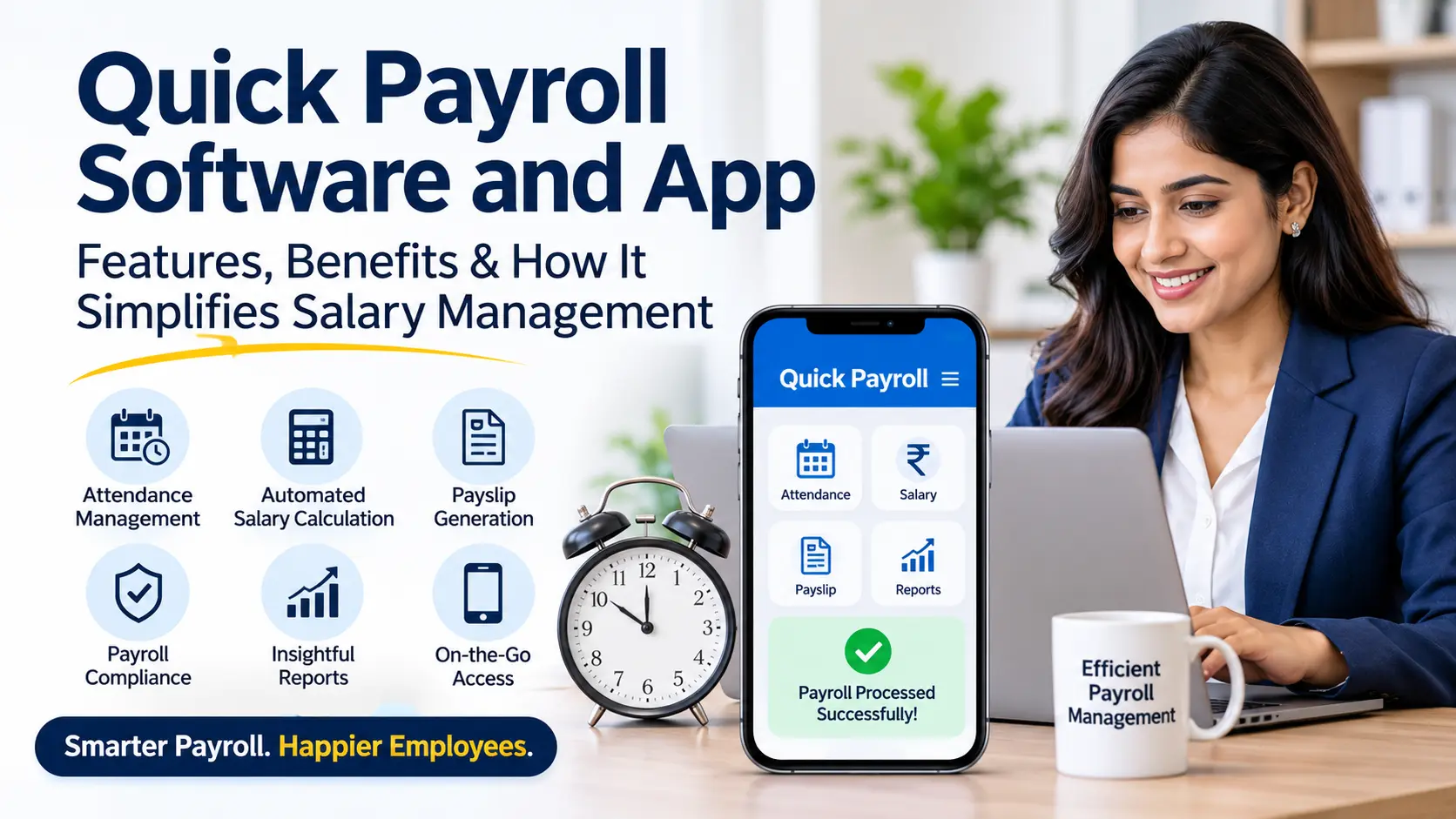
Every successful business depends on an organized workforce, and managing employee salaries is an essential part of running daily operations. From calculating monthly wages to maintaining attendance records, preparing payslips, and handling deductions, payroll management requires accuracy and proper coordination.
For businesses managing multiple employees, completing these activities manually can become challenging. Delays, calculation mistakes, and poorly maintained records can affect both employee satisfaction and administrative efficiency.
Fortunately, modern technology offers a practical solution. Quick payroll software helps organizations automate salary calculations, organize employee information, and simplify routine payroll activities.
Let's understand how businesses can improve their salary management processes with modern payroll technology.
Understanding Modern Payroll Management
Payroll management refers to the process of calculating, processing, and maintaining employee compensation records.
A typical payroll cycle includes several activities:
Maintaining employee salary information.
Tracking attendance and working hours.
Calculating monthly earnings.
Managing allowances and deductions.
Processing applicable statutory deductions.
Generating employee payslips.
Maintaining payroll reports.
Managing these activities through spreadsheets and manual records can require significant administrative effort.
A digital payroll management system brings these functions together and helps businesses maintain a more consistent process.
What Makes Quick Payroll Software Useful?
Quick payroll software is designed to reduce repetitive work associated with employee salary processing.
Instead of calculating every salary component manually, businesses can configure salary structures and use available automation features to process payroll.
Depending on the platform, businesses may benefit from:
Automated salary calculations: Calculate employee earnings based on predefined salary structures, attendance, allowances, and deductions.
Attendance integration: Connect attendance records with payroll calculations to support accurate monthly processing.
Digital payslips: Generate and distribute salary statements electronically.
Employee information management: Maintain employee records and payroll-related information in a centralized system.
Payroll reporting: Generate reports to understand salary expenses and payroll activities.
These features can make payroll administration more manageable for growing organizations.
Five Ways Payroll Applications Improve Business Operations
1. Save Time on Monthly Salary Processing
Manual salary calculations can consume several working hours, especially when an organization has a large workforce.
Payroll applications automate repetitive calculations and organize employee information, helping HR teams complete monthly payroll activities more efficiently.
2. Reduce Common Calculation Errors
Incorrect attendance information, missed deductions, and calculation mistakes can create payroll discrepancies.
Automated payroll systems use predefined rules and salary structures to support consistent calculations. However, payroll information should still be reviewed before final approval.
3. Improve Employee Access to Salary Information
Employees often need access to payslips, salary details, and payroll documents.
Employee self-service portals make it easier to retrieve this information without repeatedly contacting the HR department.
4. Organize Payroll Documentation
Maintaining accurate payroll records is important for financial administration and compliance.
Digital payroll systems help organize employee salary information, monthly reports, and relevant documentation.
5. Support Growing Businesses
As employee numbers increase, payroll administration becomes more complex.
A suitable payroll application can help businesses manage additional employees, changing salary structures, and multiple departments more systematically.
Payroll Compliance: An Important Part of Salary Management
Salary processing is not limited to calculating employee earnings. Businesses operating in India must also consider applicable statutory and regulatory requirements.
Depending on the organization and employee eligibility, payroll administration may involve:
Employees' Provident Fund (EPF).
Employees' State Insurance (ESI).
Tax Deducted at Source (TDS).
Professional Tax.
Applicable minimum wage requirements.
Overtime and leave-related calculations.
Payroll software can assist with relevant calculations and documentation, but businesses should ensure that their processes follow current applicable regulations.
How to Select Payroll Software for Your Organization
Choosing the right payroll solution requires understanding business requirements.
Before selecting a platform, consider the following factors:
Ease of use: The system should be simple for HR and finance teams to operate.
Business scalability: Check whether it can accommodate future workforce expansion.
Compliance features: Verify support for applicable Indian payroll requirements.
Data protection: Look for suitable security controls and restricted access permissions.
Integration: Check compatibility with attendance and HR management systems.
Reporting: Ensure that the application provides useful payroll and employee reports.
Technical assistance: Reliable customer support can help resolve operational issues.
A suitable payroll application should simplify existing processes rather than introduce unnecessary complexity.
Payroll Software or Payroll Outsourcing: Which Is Better?
Businesses generally have two options for managing payroll: handling the process internally using software or outsourcing payroll activities to a professional service provider.
Payroll software is useful for organizations with dedicated HR and finance teams that want greater control over internal salary processing.
Payroll outsourcing may be more suitable for businesses that need external expertise, additional administrative support, or assistance managing complex payroll operations.
Professional payroll outsourcing services may include salary processing, employee payroll documentation, and agreed compliance-related activities.
Organizations can explore Futurex Management Solutions for professional payroll management and workforce support services.
Businesses can also learn about labour compliance services to understand how professional support can help manage workplace compliance responsibilities.
Building an Efficient Payroll Management Process
An efficient payroll system requires more than purchasing software. Businesses should establish a clear monthly workflow.
A practical payroll management process includes:
Update employee information and salary structures.
Collect attendance and leave records.
Verify overtime and additional earnings.
Calculate gross salary and applicable deductions.
Review payroll reports and resolve discrepancies.
Approve salary payments.
Generate payslips and maintain records.
Following a consistent process helps organizations improve payroll accuracy and maintain better administrative control.
Conclusion
Employee salary management is an important responsibility that directly influences business operations and workforce satisfaction.
Quick payroll software helps organizations simplify salary calculations, manage employee information, organize documentation, and reduce repetitive administrative work.
Whether a company chooses an internal payroll application or professional outsourcing support, the priority should be maintaining an accurate, transparent, and efficient payroll process.
By combining appropriate technology with effective administrative practices, businesses can make payroll management easier while focusing more attention on their core operations.
About Futurex Management Solutions
Futurex Management Solutions provides payroll management, staffing, HR support, and labour compliance services to businesses. Its services help organizations streamline workforce administration and manage important employee-related processes.