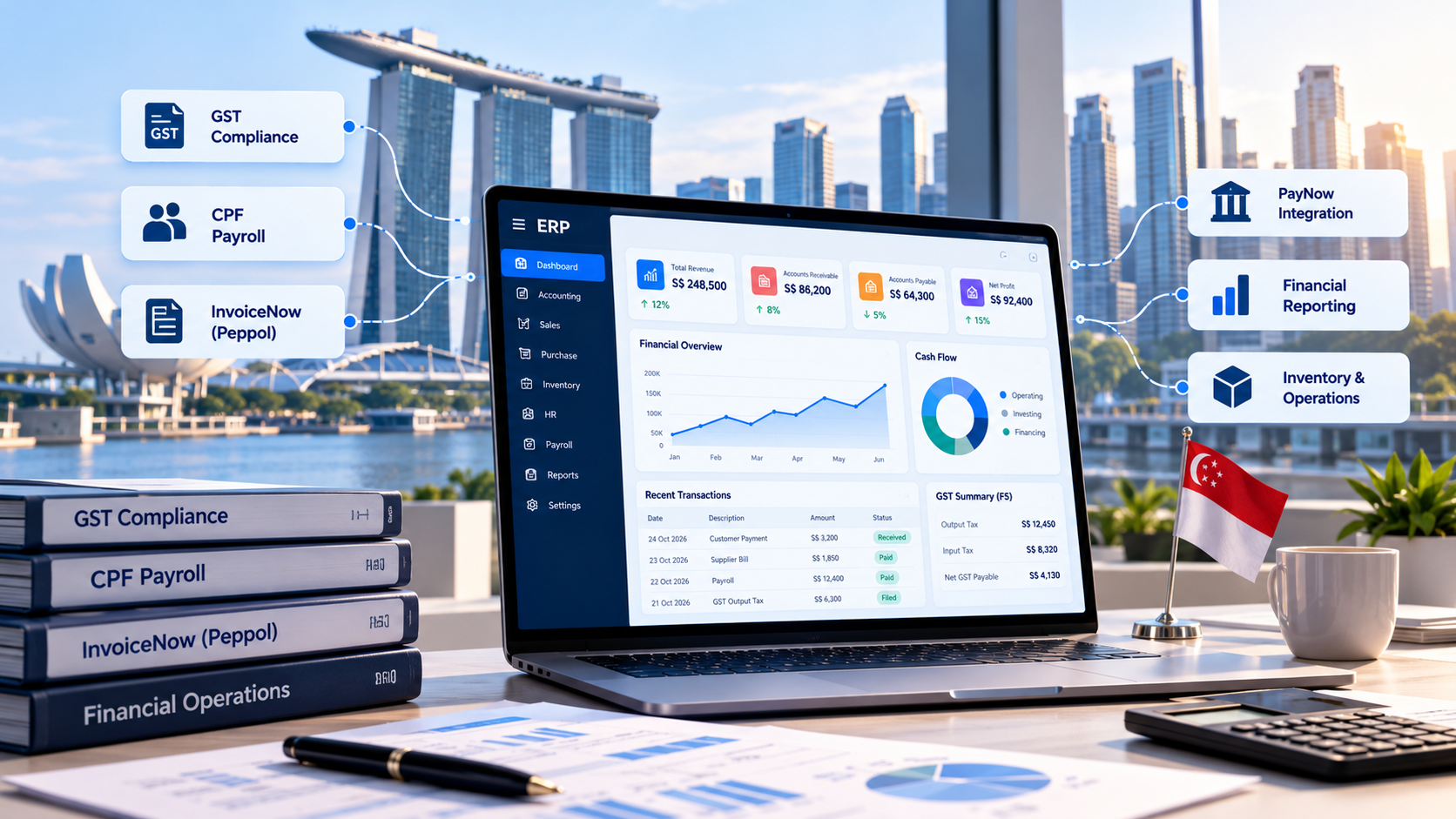
Running a business in Singapore means handling GST returns, CPF payroll, e-invoicing rules, and fast digital payments, often on top of daily operations. Many small and mid-sized companies still handle this with spreadsheets, separate accounting tools and manual bank checks. That approach is slow, and it creates risk when regulations change.
This is where ERP in Singapore adds real value. An Enterprise Resource Planning (ERP) system brings accounting, invoicing, payroll, inventory and reporting into one platform, so your finance team works from a single source of truth.
What Is an ERP System?
An ERP system is business software that connects core functions such as finance, sales, purchasing, HR and inventory in one database. Instead of re-entering the same data in several tools, every department sees the same live numbers.
For finance teams, a modern ERP typically covers:
- General ledger, accounts payable and accounts receivable
- Multi-currency invoicing and bank reconciliation
- GST calculation and reporting
- Payroll with statutory contributions
- Real-time dashboards and financial reports
Why Singapore Businesses Need ERP Software
Singapore is a highly digital economy with strict compliance expectations. Businesses must charge GST correctly, pay employee contributions on time, keep accurate records and increasingly send invoice data electronically. An ERP built or configured for Singapore reduces manual work in all of these areas.
Key benefits include:
- Fewer errors: automated tax and payroll calculations replace manual formulas.
- Faster month-end closing: transactions flow directly into the ledger.
- Better cash flow visibility: live receivables, payables and bank positions.
- Audit readiness: every entry has a clear trail.
- Scalability: the same system supports you as you add staff, entities or markets.
IRAS Compliance and GST Automation
Singapore’s GST rate is 9%, in effect since 1 January 2024. Registration becomes compulsory when taxable turnover exceeds S$1 million on either a retrospective or prospective basis. GST-registered businesses report output tax and input tax to IRAS, usually through quarterly GST F5 returns.
A well-configured ERP supports IRAS compliance by:
- Applying the correct tax code (standard-rated, zero-rated, exempt or out-of-scope) to each transaction
- Producing GST reports that match your ledger
- Keeping records organised for IRAS queries or audits
- Supporting corporate income tax preparation, since the headline company tax rate is 17% of chargeable income
Getting Ready for InvoiceNow
Singapore is moving toward nationwide e-invoicing through InvoiceNow, which runs on the Peppol network. IRAS announced that the GST InvoiceNow requirement will extend to all GST-registered businesses in phases, with full adoption by April 2031. New voluntary GST registrants have been required to use it since 1 April 2026. IRAS will bring in existing GST-registered businesses based on their annual supplies, so check your date with IRAS.
An ERP that can issue and transmit Peppol-compliant e-invoices will save you from a rushed system change later. IRAS has also noted that submitting invoice data directly can lead to faster GST audits and quicker GST refunds.
CPF Payroll Made Simple
Payroll is one of the most error-prone areas for growing teams. CPF rules depend on age, residency status and wage type, and they change.
Key points for 2026:
- The monthly Ordinary Wage ceiling rose from S$7,400 to S$8,000 on 1 January 2026.
- For employees aged 55 and below, the total contribution is 37% (17% employer and 20% employee).
- Rates for employees aged 55 to 65 increased from 1 January 2026. For example, employees above 55 to 60 now have 16% employer and 18% employee shares.
- The annual CPF salary ceiling remains S$102,000, so the Additional Wage ceiling for bonuses is S$102,000 minus Ordinary Wages already subject to CPF that year.
- Contributions are due by the 14th of the following month (or the next working day if it falls on a weekend or public holiday). Late payment attracts interest of 1.5% per month.
An ERP with a CPF payroll module can apply age-based rates, enforce wage ceilings, generate the CPF submission file and keep payslips accurate. This is far safer than updating spreadsheets by hand each January.
PayNow Integration for Faster Payments
Digital payments are now standard in Singapore. PayNow integration lets your ERP match incoming payments to invoices much faster.
- PayNow Corporate: businesses link their UEN to a bank account, so customers can pay using your UEN. Your ERP can use payment references to auto-match receipts to open invoices.
- PayNow QR: QR codes on invoices or checkout screens allow customers to pay instantly, which reduces overdue accounts.
- CPF payments: employers can pay CPF contributions through PayNow QR or direct debit via CPF EZPay.
When PayNow data feeds into your bank reconciliation, month-end tasks that took days can take hours.
ERP Development in Singapore: Off-the-Shelf or Custom?
Businesses usually choose between two paths:
- Ready-made cloud ERP: quick to deploy, subscription-based, and suitable for standard accounting needs.
- Custom ERP development in Singapore: built around your workflows, approval chains, industry rules and integrations, such as banks, e-commerce platforms, logistics partners or government portals.
Custom development makes sense when you have complex approval processes, unique billing models, multiple entities, or need tight integration with existing tools. When evaluating a provider of ERP development in Singapore, look for:
- Local knowledge of GST, CPF and InvoiceNow rules
- Experience with Peppol and bank integrations
- Strong data security and access controls
- Clear support for ongoing regulatory updates
- A proven implementation and training plan
How to Choose the Right ERP
Before you decide, ask these questions:
- Does it support GST, CPF and InvoiceNow out of the box or by configuration?
- Can it reconcile PayNow and bank feeds automatically?
- Will it scale with headcount, entities and transaction volume?
- Is the reporting flexible enough for management, directors and auditors?
- What is the total cost, including implementation, training and support?
Also check whether your business qualifies for any current government support for digital adoption, as available schemes change from time to time.
Final Thoughts
For Singapore businesses, ERP is no longer a luxury for large enterprises. With 9% GST, evolving CPF rules and the shift to InvoiceNow, an integrated system helps you stay compliant, reduce manual work and make decisions from real numbers. Whether you choose a cloud ERP or invest in custom ERP development, the goal is the same: simpler accounting, accurate payroll and confident financial operations.
This article is for general information only. Always confirm current rules with IRAS, CPF Board or a qualified professional.