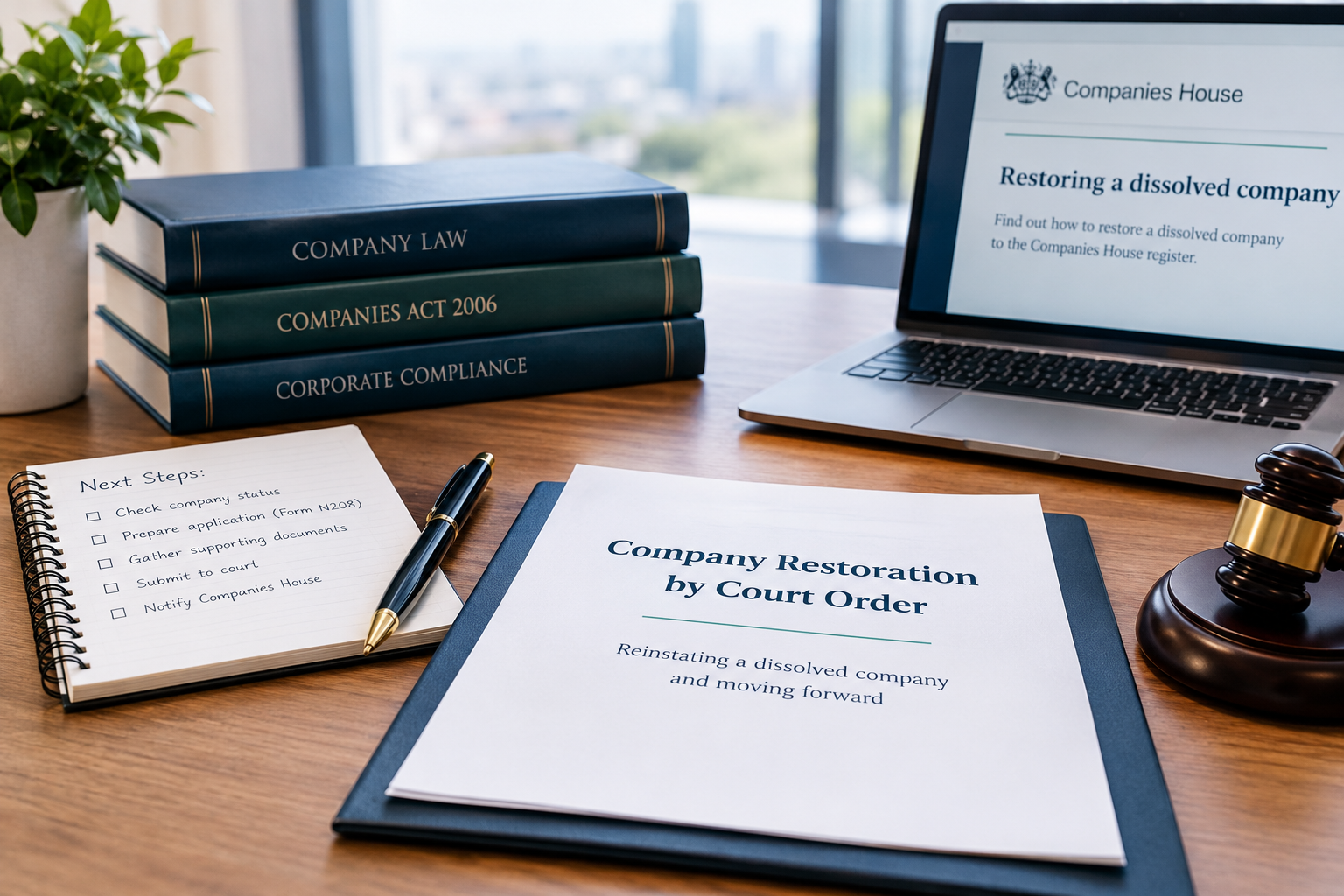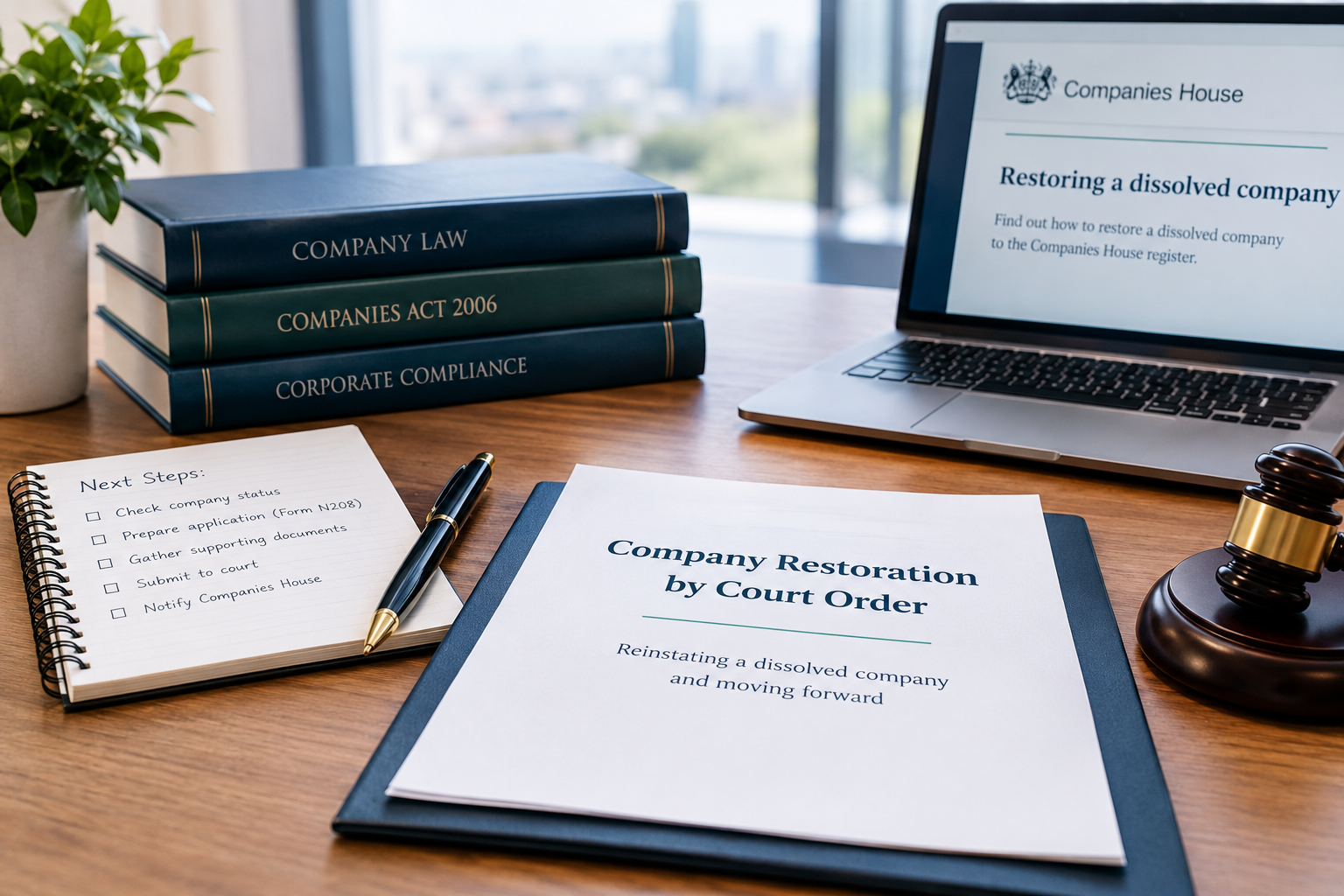
A dissolved company may appear to be a closed chapter, but there are situations where restoring it to the Companies House register becomes necessary. A former director may need to recover company assets, a creditor may want to pursue an unpaid debt, or another interested party may need to bring legal proceedings against the business.
In these circumstances, company restoration by court order can provide a legal route to bring the company back onto the register. However, the process involves specific eligibility rules, court procedures, supporting documents, and time limits that applicants should understand before taking action.
This guide explains how court restoration works, who can apply, what documents may be required, and what happens after a company is restored.
What Is Company Restoration by Court Order?
Company restoration by court order is a legal process through which a dissolved or struck-off company can be returned to the Companies House register following a court's decision.
In England and Wales, the process is principally governed by sections 1029 to 1034 of the Companies Act 2006. The court considers the circumstances of the case before deciding whether restoration is appropriate. Read the official Companies House guidance.
Restoration may be necessary when a company has been removed from the register but still has unresolved financial, legal, or property matters.
For example, a business may have owned property that needs to be dealt with, or a supplier may discover that the company that owes them money has been dissolved. Restoring the company may allow the relevant matter to be addressed through the appropriate legal process.
It is important to understand that restoration does not automatically settle debts, recover assets, or guarantee a successful legal claim. It restores the company's legal status so that further action can be considered.
Why Might a Company Need Court Restoration?
There are several reasons why restoring a dissolved company may be necessary.
Recovering company assets: A dissolved company may have owned money, property, or other assets that were not dealt with before dissolution. Restoration may help address the legal position and enable appropriate steps to be taken.
Pursuing unpaid debts: A creditor may need the company restored before pursuing a claim or taking further enforcement action.
Resolving contractual disputes: A former customer, supplier, or business partner may have an unresolved contractual matter involving the dissolved company.
Dealing with legal claims: Restoration may be required to bring or continue certain proceedings involving the company.
Addressing property interests: A company may have had rights or obligations relating to land or other property that need to be resolved.
The appropriate route depends on the reason for restoration, how the company was dissolved, and the applicant's relationship with it.
Who Can Apply for Company Restoration by Court Order?
Not everyone can apply to restore a dissolved company. The applicant must fall within an eligible category under the relevant legislation.
Depending on the circumstances, eligible applicants may include:
Former company directors.
Former shareholders or members.
Creditors who were owed money.
Former liquidators.
Individuals with a potential legal claim against the company.
People with certain interests in land or property connected with the company.
Other individuals or organizations recognized by the legislation.
The court may also consider applications from other qualifying parties where the statutory requirements are met.
Before starting the process, applicants should establish their eligibility and identify the legal reason for restoring the company. Supporting evidence may be needed to demonstrate their connection with the business and explain why restoration is appropriate.
The rules can differ depending on the company's history and the jurisdiction involved. Applicants should therefore check the relevant requirements rather than assuming that a previous connection with the company automatically gives them the right to apply.
Company Restoration by Court Order: The Application Process
The process involves several stages. Preparing the application carefully can help reduce avoidable delays and ensure the court receives the information it needs.
Step 1: Check the Company's Status
Begin by checking the company's record on Companies House.
Confirm the company's registered name, company number, dissolution date, and available filing history. It is also useful to establish whether the company was struck off voluntarily, removed by the registrar, or dissolved following insolvency proceedings.
This information helps determine whether court restoration is available and whether another restoration route may be more suitable.
Step 2: Establish the Reason for Restoration
The applicant should identify the practical reason for restoring the company.
For example, the application might relate to an unpaid debt, an unresolved property interest, or a potential legal claim. The reason should be supported by relevant documents wherever possible.
Evidence may include contracts, invoices, correspondence, property records, or other documents showing the connection between the applicant and the dissolved company.
Step 3: Complete Form N208 Where Applicable
For court restoration applications in England and Wales, applicants generally use form N208, the claim form for restoring a company by court order.
The form must be completed accurately, with the appropriate details about the company and the requested order. Applicants should follow the current official guidance and check that they are using the correct procedure for their circumstances.
Applications in Scotland and Northern Ireland follow different court procedures, so the England and Wales process should not automatically be applied to those jurisdictions.
Step 4: Prepare the Supporting Documents
A court application generally requires supporting evidence explaining why restoration is being requested.
This may include a witness statement setting out the relevant background, the applicant's interest in the matter, and the reasons the company should be restored.
Additional documents may be needed depending on the circumstances. For example, a creditor may need evidence of the debt, while a property-related application may require documents showing the company's interest in the property.
Careful preparation is important because missing information or unclear evidence can complicate the process.
Step 5: Submit the Application and Pay the Relevant Fee
Applicants must submit the completed claim and supporting documents to the appropriate court, following the applicable filing procedure.
The court fee should be checked against the latest official guidance before submission, as fees can change. Applicants should also confirm the correct court and service requirements for their particular case.
Where necessary, the application must be served on the relevant parties in accordance with the applicable rules.
Step 6: Obtain the Court's Decision
The court considers the application and determines whether restoration is justified under the relevant legal provisions.
If the court grants the order, a copy must be delivered to the Registrar of Companies. Restoration takes effect when the order is delivered to the registrar in accordance with section 1031 of the Companies Act 2006.
The exact time required depends on the circumstances, the quality of the application, and the court's process.
What Is the Time Limit for Court Restoration?
In most cases, an application for court restoration must be made within six years of the company's dissolution.
However, there are important exceptions. Applications connected with personal injury claims may be made outside the usual six-year period, subject to the applicable legal requirements. There is also a specific exception involving certain refusals of administrative restoration applications.
Under section 1030 of the Companies Act 2006, a qualifying application relating to personal injury may be made at any time, although other legal time limits affecting the underlying proceedings may still matter.
Applicants should not assume that every case follows the same deadline. The company's dissolution date, the circumstances of its removal, and the purpose of the application should all be reviewed before proceeding.
For more information, consult the official legislation on company restoration.
What Happens After a Company Is Restored?
When the court orders restoration, the company is generally treated as having continued in existence as though it had not been dissolved or struck off the register. This principle is set out in section 1032 of the Companies Act 2006.
However, restoration may create further administrative and financial work.
The company may need to review its Companies House record, address outstanding filing requirements, update relevant business records, and assess any continuing tax or compliance responsibilities.
The position should be reviewed carefully because the company's circumstances may have changed significantly during the period of dissolution.
Restoration can also affect the treatment of assets that passed to the Crown or another relevant authority as bona vacantia. The outcome depends on the asset and the circumstances, and restoration does not necessarily reverse every transaction involving such property.
Where debts, disputes, or legal claims are involved, additional proceedings may still be necessary after restoration.
Can You Restore a Company Without a Court Order?
In some cases, yes. Administrative restoration may be available to a former director or shareholder where the company was struck off by the registrar, meets the relevant statutory conditions, and the application is made within the permitted period.
The process generally involves submitting form RT01 to Companies House and meeting the applicable requirements.
Administrative restoration is not available for every dissolved company. For example, where the company was voluntarily struck off, or the applicant does not meet the relevant eligibility conditions, a different route may be necessary.
You can review the official guide to restoring a dissolved company to understand the available options.
Choosing the correct procedure at the beginning can save time and help avoid unnecessary expense.
How Tilly & Cooper Can Help
Restoring a dissolved company can involve legal procedures, company records, financial documents, and ongoing compliance considerations. Understanding the company's history and identifying the correct next steps are important parts of preparing for restoration.
Tilly & Cooper provides corporate accounting and company compliance support to individuals and businesses across the UK. Depending on your requirements, professional support may help you review relevant company records, identify outstanding accounting matters, and understand the financial and administrative work that may follow restoration.
Court applications themselves may require advice from a suitably qualified solicitor, particularly where there are disputes, complicated property interests, or questions about eligibility.
To explore the available support, visit Tilly & Cooper and discuss your company's circumstances.
Frequently Asked Questions
1. How long does company restoration by court order take?
The timeframe depends on the court's workload, the complexity of the case, and whether the application contains all the required information. There is no single timeframe that applies to every application.
2. What form is used for court restoration?
Form N208 is generally used for applications to restore a company by court order in England and Wales. Different procedures apply in Scotland and Northern Ireland.
3. Can a creditor apply to restore a dissolved company?
Yes. A qualifying creditor may be eligible to apply where the company owed them money at the relevant time. The creditor must meet the applicable legal requirements and provide appropriate supporting evidence.
4. Can a company be restored after six years?
In some circumstances, yes. Although the usual deadline is six years from dissolution, exceptions exist, including qualifying personal injury claims and certain cases involving refused administrative restoration. Eligibility should be checked against the relevant legislation.
5. Does restoration automatically recover company assets?
No. Restoration can help address the company's legal position, but recovering assets may require additional steps. The treatment of property previously vested as bona vacantia depends on the circumstances and relevant legal provisions.
6. Should I seek professional advice before applying?
Professional advice can be useful, especially where the company has outstanding debts, disputed assets, complex filing issues, or a potential legal claim. A solicitor can advise on the court process, while an accountant can assist with relevant financial records and accounting matters.
Final Thoughts
Company restoration by court order can provide a way to resolve outstanding matters involving a dissolved business. However, the correct procedure depends on the company's history, the applicant's eligibility, and the purpose of the application.
By checking the company's status, understanding the relevant time limits, preparing suitable evidence, and following the correct court procedure, applicants can approach restoration more confidently.
If you are considering restoring a dissolved company, review the official Companies House guidance and seek appropriate professional advice before submitting an application. Taking the right steps early can help you understand the process and prepare for the responsibilities that may follow restoration.